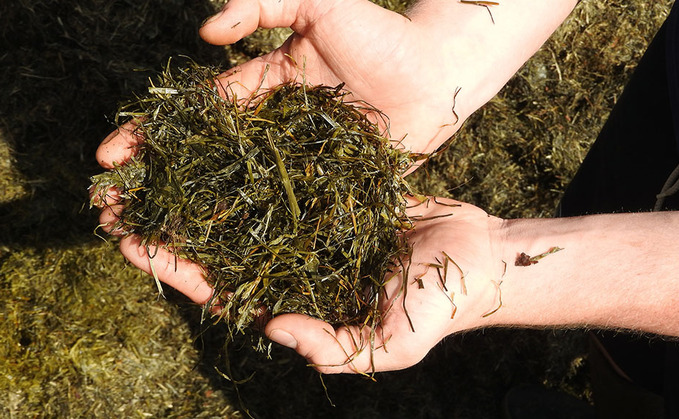
Applying a silage additive to multi-cut grass silage can help create a more stable fermentation and cut dry matter losses in the clamp by half, according to recent trial work.
Improved quality and digestibility are the main reasons more farmers are adopting multi-cut silage systems, but such benefits can also create challenges at ensiling, making a silage additive a must.
Multi-cut stems around cutting grass more frequently at around four-week intervals.
This means grass is younger, more digestible and higher in metabolisable energy (ME) and protein.
As a result, cows can eat more of it, boosting forage intakes and thus .
However, Volac silage microbiologist, Mark Leggett, says this can also create issues in the clamp.
"The shorter cutting window can result in higher residual nitrogen levels from fertiliser which, when combined with the potentially higher protein levels, can increase buffering capacity of the crop," he explains.
Consequently, pH does not drop as fast.
This increases the likelihood that bad bacteria will start to grow and take over the process, leading to dry matter and .
Dr Leggett carried out an onfarm trial looking at fresh grass quality on a multi-cut system and fermentation and silage quality when a silage additive was and was not applied.
Analysis of fresh, standing grass on the multi-cut system showed this younger grass was naturally low in lactic acid bacteria - compounding the issue at ensiling as there was less bacteria present to drop pH.
There was also evidence of enterobacteria (commonly associated with slurry), despite the use of trailing shoe application.
Treating this multi-cut silage with Ecosyl silage additive resulted in several benefits:
1. A faster drop in pH
The beneficial bacteria in Ecosyl were able to generate more lactic acid than the untreated crop, resulting in a rapid decline in pH.
The pH in untreated silage fell much slower and never reached the level seen in the .
2. Less undesirable bacteria and VFAs
Ecosyl treated silage controlled the growth of enterobacteria and restricted the production of volatile fatty acids (VFA), including butyric acid.
In the untreated silage, where pH remained high for at least seven days, enerobacteria counts were higher, as were butyric acid levels.
3. Less dry matter losses
Dry matter losses in the treated crops were minimal at 3-7% across the four cuts.
This compared to 5-14% in the untreated crops.
This was due to better control of undesirable bacteria as a result of better fermentation in the treated silage.
Dr Leggett says it is difficult to say if the trends seen are an inherent multi-cut issue.
However, he says all of the four cuts in this trial were consistently difficult to ensile.
"The starkest result is the dry matter loss.
On average, treating with Ecosyl halved DM losses.
That's a lot to throw away for the sake of using an additive," says Dr Leggett.
"If you've done all the hard work in producing a high-quality crop on a multi-cut system - to just allow it to spoil in the clamp is a tremendous waste," he says.

The Trial
- Four-year-old perennial ryegrass leys n Received 45 units of N/acre and 3,000 gallons of slurry/acre six weeks before first cut
- 35 units of N/acre and 1,500 gallons slurry/acre applied after each cut
- Slurry applied with trailing shoe
- Cuts taken every four weeks during May-August.
- Four cuts analysed in trial
- Grass was either untreated or received Ecosyl (Lactobacillus plantarum MTD/1 at one million cfu/g forage)