Getting oilseed rape crops in early can ensure it is better placed to resist cabbage stem flea beetle attack. Farmers Guardian summarises the latest advice from a new guide.
Well-established oilseed rape crops can survive a large amount of autumn stress and damage. They are, however, vulnerable to both the weather and pests from germination through the cotyledon stage to two true leaves.
According to The Guide to Early OSR Drilling, recently published by Bayer and Opico, sowing in the first half of August aims to ensure crops are securely beyond their most vulnerable stage before the peak of flea beetle migration.
Providing there is sufficient moisture, this has been found to be very valuable in enabling crops to tolerate levels of flea beetle grazing that might otherwise devastate them, says the guide.
Tips for early drilling of OSR
- Fundamental to success are well-structured, biologically-active soils without compaction, seedbeds with sufficient moisture and the best seed-to-soil contact
- Seed rates should be constrained to reduce spring problems, seed sown at a consistent 2-3cm depth for the most even emergence, and, seedbed fertiliser applied where possible
- Any soil structural issues are best corrected ahead of the previous crop, which needs to be chosen with care to give the most-timely entry for early sowing
- Nurse or companion crops may reduce CSFB attractiveness and freshly emerged brassicas in cover or catch crops sown one to two weeks after the OSR can act as useful ‘trap crops'Ìý
- Vigorous establishment is essential in varieties for early drilling, together with faster-than-average but not excessively rapid autumn development, and early or fast spring growth
- First class standing power and strong light leaf spot resistance should also be prioritised in variety choice, while good verticillium and TuYV resistance may be valuable
- Early-August drilling needs to be undertaken with particular care if its benefits in reducing adult cabbage stem flea beetle grazing damage are not to be offset by subsequent management problems
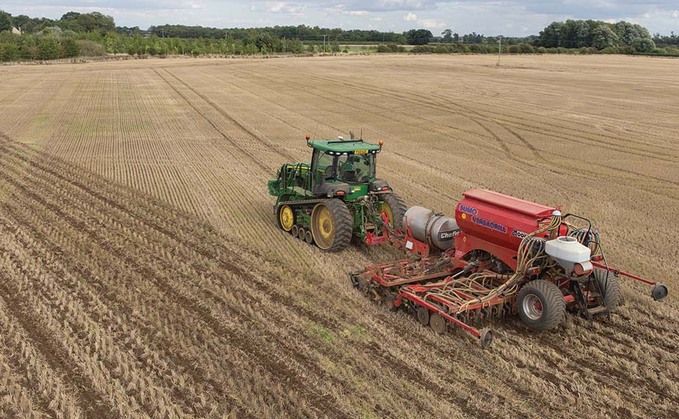
- Single pass, minimal disturbance establishment is essential, with seed ‘drilled' rather than just dropped behind a leg or scattered on the ground
- No-till drilling can be adopted where the soil is in good enough condition or tailored seeding with low disturbance subsoiling employed if there are any structural concerns
- Light leaf spot control should be a particular priority, with leaf infections identified by incubation before they become visible
- Autumn plant growth regulation may be needed and particular canopy management care is advisable based on GAI and judicious use of spring PGRs
Source: The Guide to Early OSR Drilling, Bayer and Opico
Benefits to early OSR establishment
As well as helping with flea beetle control, there are other benefits to sowing OSR early.
Rapid, minimum disturbance OSR sowing immediately after combining can take advantage of surprisingly high levels of soil moisture beneath most cereal canopies.
Early-August-sown crops also benefit from substantially more thermal time to establish themselves ahead of winter than those sown later and sowing four weeks earlier can result in an additional 4-5 leaves ahead of winter as well as significantly increased rooting.
This leaves developing OSR better placed to tolerate winter waterlogging and pigeon grazing, in particular.
The higher early spring green area indices (GAIs) that result can significantly reduce the amount of nitrogen fertiliser required for the most productive canopies. Earlier-drilled crops are generally at less risk from phoma and subsequent stem cankering, and have a higher infection threshold for spraying.