



Ask many farmers what has changed most since 2022 and energy costs will usually be near the top of the list. Electricity has become harder to predict, harder to budget for and far more important to day-to-day operations than many businesses realised. That is one reason more farms are now investing in on-site energy generation alongside traditional infrastructure.
The numbers tell part of the story. In March 2026 alone, more than 27,000 new solar installations were completed across the UK, the highest monthly figure since 2012, pushing the national total past two million systems. The government's Department for Energy Security and Net Zero points directly to fuel price volatility and geopolitical instability as key drivers behind this growth. Farms, with their large roof areas, open land and high electricity demand, are naturally positioned to benefit.
But solar is only part of the equation. For farms in genuinely windy locations, such as exposed coastal sites, upland areas or open fields without shelter belts, small wind turbines can generate electricity precisely when solar production is weakest: during dark winter months and overnight, when many agricultural operations still consume large amounts of power.
The Wind Opportunity
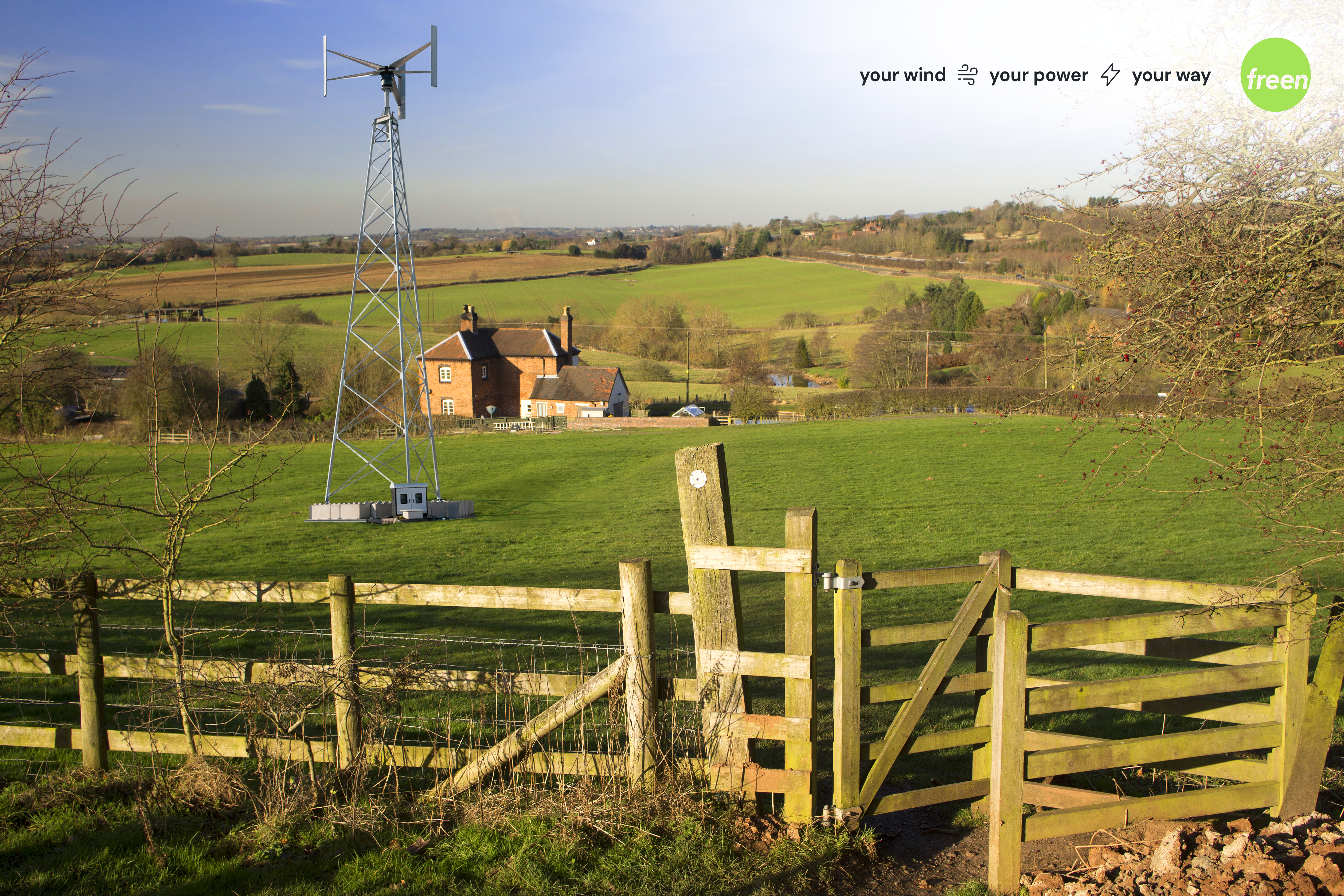
Freen, the Estonian manufacturer behind the Freen-9 vertical-axis wind turbine, is seeing increasing interest from the UK agricultural sector for this reason. The Freen-9 is a 9 kW vertical-axis wind turbine with a 6-metre rotor diameter, a tower height configurable between 4 and 18 metres, and a 20-year design life. Its cut-in speed of 3.5 m/s allows generation in relatively moderate wind conditions, while the vertical-axis design captures wind from any direction, which can be beneficial on farm sites where wind patterns shift throughout the year.
The economics depend heavily on location, and Freen is open about that reality. An analysis based on long-term Met Office wind averages estimates annual production of around 4.85 MWh for a typical open farm in East Anglia, compared with approximately 13.7 MWh for a well-positioned site in northern Scotland. The difference highlights the importance of proper siting. Even small changes in turbine placement can significantly affect annual production and financial returns.
In stronger wind regions such as northern Scotland, the Freen-9 can generate approximately 13.7 MWh of electricity annually, enough to offset a significant share of a typical farm's electricity demand and reduce energy costs by around 拢3,000 per year under current UK electricity prices. The turbine uses a direct-drive permanent magnet generator with relatively few moving components, helping reduce maintenance requirements over its operational lifetime. Freen also cites a noise level of 45 dB at 100 metres and planning requirements that are often simpler than those associated with larger wind projects.
Why Hybrid Systems Make Sense
Ask any farmer with solar panels what frustrates them most and the answer is usually the same: the panels do very little precisely when the farm needs power most. Milking, heating, grain drying and frost protection all peak in autumn and winter, when daylight is shortest and solar generation is weakest.
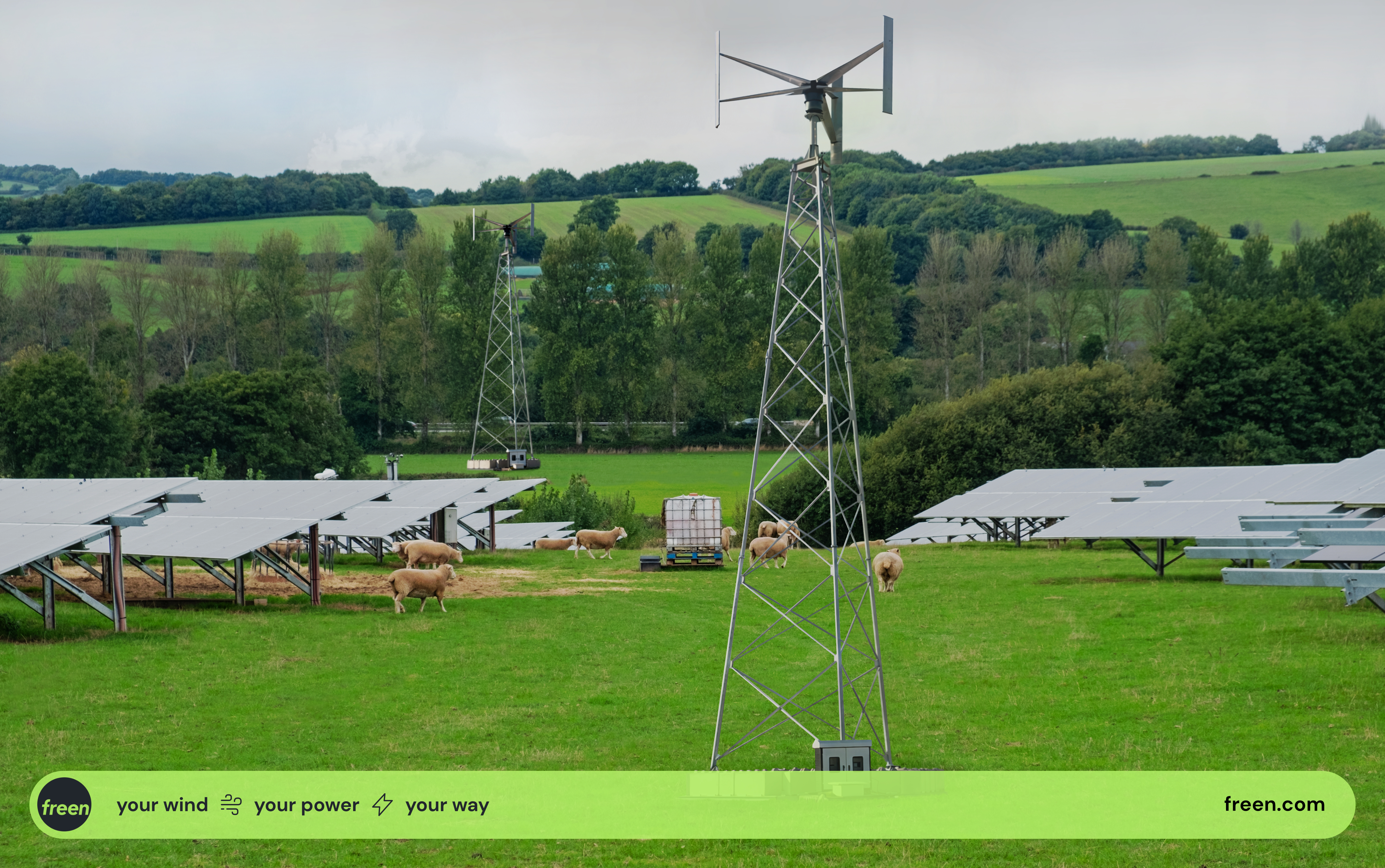
A wind turbine works on a completely different schedule. When Atlantic storms roll in during November, the Freen-9 is working hard. When cold winter weather settles across the country in January and solar output drops, a steady wind can keep the turbine turning.
This is what a hybrid system delivers in practice: fewer periods of drawing entirely from the grid at peak prices, more opportunities to use electricity generated on-site, and a production profile that follows the rhythm of a working farm rather than fighting against it. For livestock farms in particular, where electricity demand is constant and largely non-negotiable, that kind of seasonal balance matters far more than headline generation figures.
A battery system, even a relatively modest one, strengthens this further. Energy generated overnight or during the middle of the day that is not immediately needed can instead be stored for evening milking, feeding systems or other later demand, rather than exported back to the grid at lower rates. The result is a system that behaves less like a standalone generator and more like a buffer between when electricity is produced and when the farm actually needs it.
Energy Independence as a Business Asset
For many farms, energy has become one of the least predictable operating costs. Electricity prices, fuel costs and wider inflationary pressures have all affected margins over the past several years. As a result, more businesses are starting to view on-site generation not simply as sustainability branding, but as practical risk management.
A farm that produces a significant share of its own electricity and uses more of that power directly on-site is reducing exposure to future price volatility. That is what infrastructure investment means in practice: building long-term capability into the business itself.
For farms with strong wind conditions, the combination of wind, solar and battery storage can provide a more stable and resilient energy strategy over the next two decades. The starting point, however, is always an honest assessment of the wind resource at the actual installation site, rather than relying only on regional averages.
For technical specifications, AEP data and to discuss your farm's wind resource, visit freen.com or contact [email protected]
听
About Freen
Freen is an Estonian manufacturer of small wind turbines and energy storage systems focused on hybrid renewable energy solutions for farms, homes and commercial applications. The company designs and manufactures its systems in Europe, with a focus on combining wind, solar and storage for long-term energy resilience.
听
听


